Game Ad Revenue Distribution Platform
2025.12 – 2026.05 · Client project · Spring Boot, Vue 3, Unity SDK
Overview
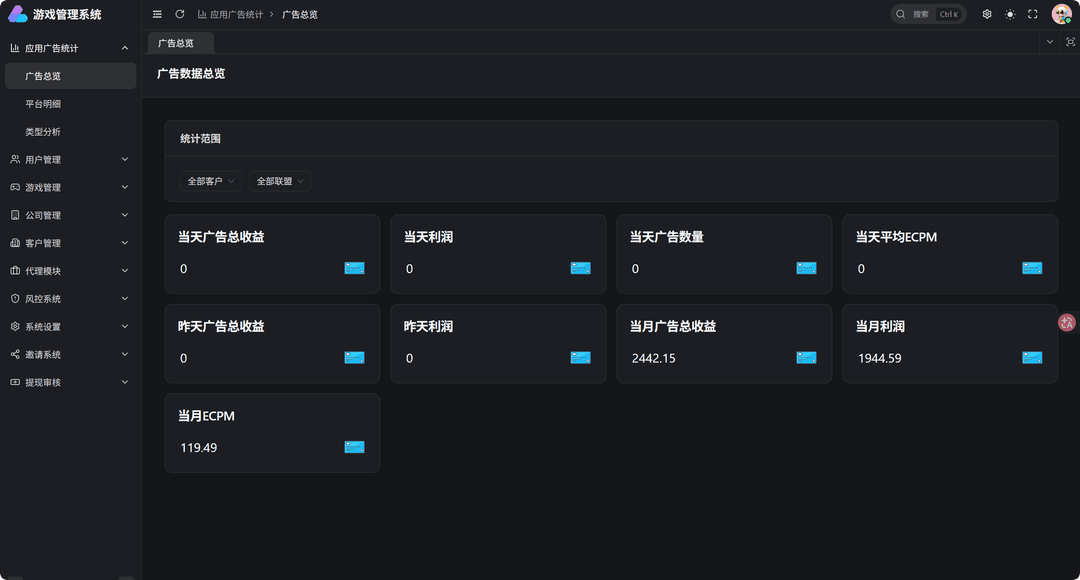
The game distribution system is an end-to-end system for game ad monetization and channel distribution. It covers ad callbacks, revenue settlement, agent commission, data statistics, and automated APK production and distribution. The business flow is: ad impression → risk check → revenue attribution → settlement review → operations analysis.
Project structure
Backend: Spring Boot + MyBatis Plus + Redis
App: a game download hall, with revenue details, withdrawal, invitation and other features
Unity SDK: a one-stop ad SDK that lets existing Unity games add platform features such as login, registration, invitation and withdrawal
Tech
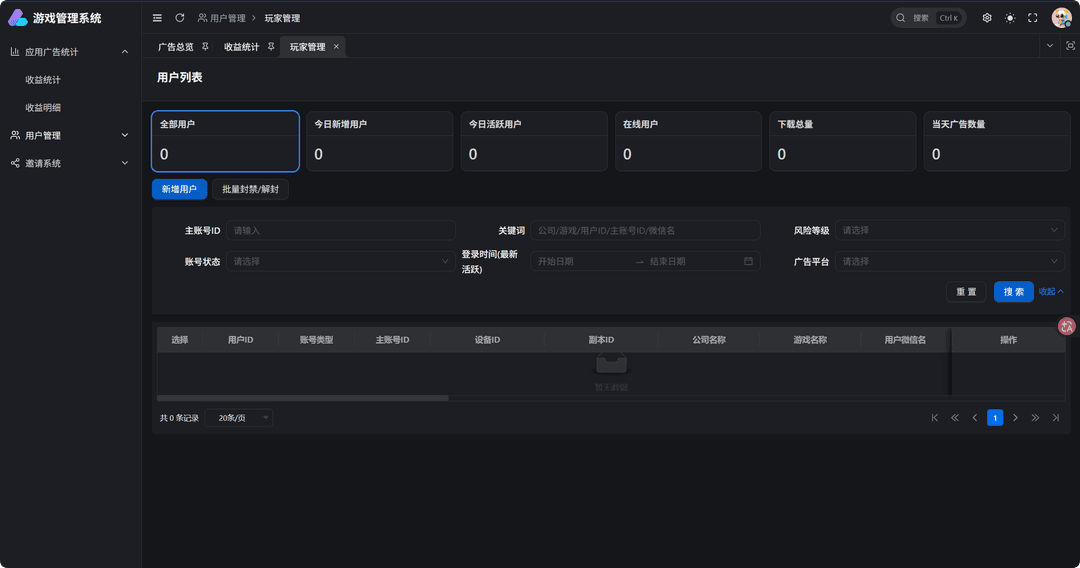
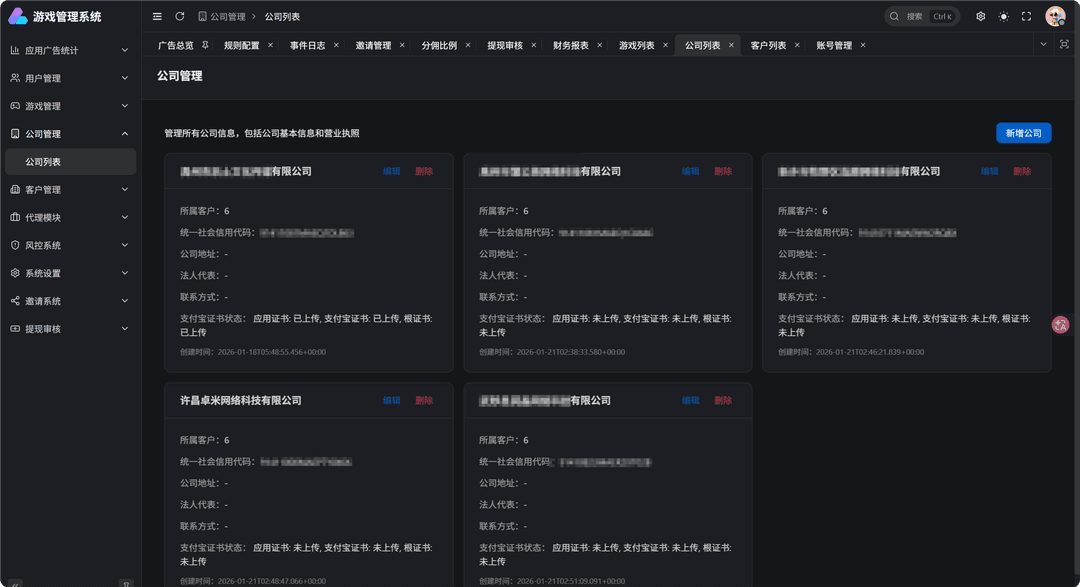
The backend core services are built with Spring Boot + MySQL. A multi-role operations console uses Vue 3 + Vben Admin. A Unity SDK and an automated APK build pipeline come with it, and the system runs multiple merchants, agents and versions in parallel. Under complex business constraints, the system focuses on these engineering problems: out-of-order and idempotent ad callbacks, auditable commission accounting, multi-dimensional statistics performance, and multi-tenant and agent permission convergence.
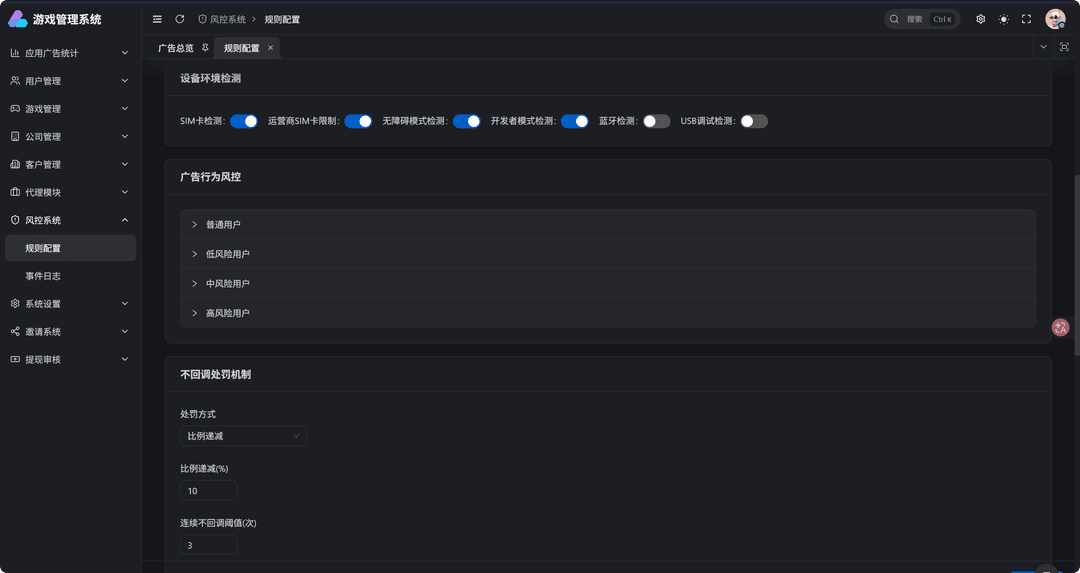
At the risk control layer, the system does not treat an ad callback as valid revenue directly. It adds multi-dimensional checks and risk isolation in the callback path:
a request-level unique ID (requestId + appId) merges events such as onLoad / onClick / onCallback, which prevents out-of-order and duplicate pushes. The callback order, event completeness, and device and package version information decide whether a record becomes settleable. Rewards and commission fire only on the "first valid callback". This avoids, at the source, revenue inflation from fake callbacks, replayed requests and abnormal event chains. Every revenue change is stored as "before / after", forming an auditable ledger for later risk review and manual audit.
On the ad side, the system merges and de-duplicates multi-event callbacks (onLoad / onClick / onCallback). Rewards and commission fire only on the first valid callback, so nothing is settled twice. On the data side, incremental aggregation and a multi-dimensional daily summary model move frequent statistics queries from detail calculation to aggregate table reads, which directly supports the real-time operations board. On the permission side, the boundaries of "role + tenant + agent level + field level" are unified and enforced the same way in front end and backend, which lowers the risk of unauthorized access.
The project also has a built-in automated APK production and task queue system. It turns repackaging, signing, distribution and failure recovery into an engineering pipeline, and connects to the runtime data attribution of the Unity SDK. This makes it practical to ship and maintain many agent versions.
Besides the features themselves, the project pays attention to stability, traceability, permission checks and later extension.