FPSMaster
2021 – 2026.12 · Open source, lead developer · Java, Kotlin, Rust, Tauri
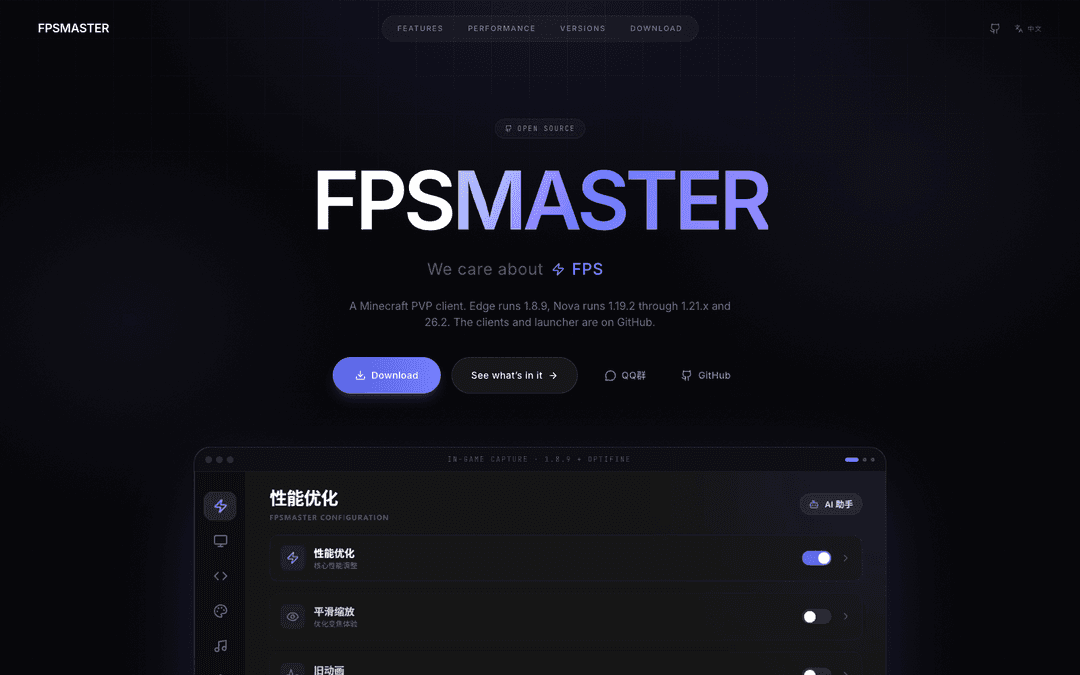
FPSMaster is a free Minecraft PVP client. Its website is fpsmaster.top and its GitHub organization is FPSMasterTeam. I am the main maintainer: I wrote the client, launcher, backend, website, and shared libraries, and about ten other contributors have submitted code. The website says the project started in 2021. My earliest repository record is from July 2023. Maintenance stops on 31 December 2026. The final versions are released and all the source is public.
What problem it solves
PVP players want stable frame rates, low latency, and enough HUD information. The usual setup is OptiFine plus a few separate mods. FPSMaster puts optimization, HUD, replay, music, and cosmetics into one client, with a launcher to manage instances.
Products
| Name | What it is | Technical approach | Status |
|---|---|---|---|
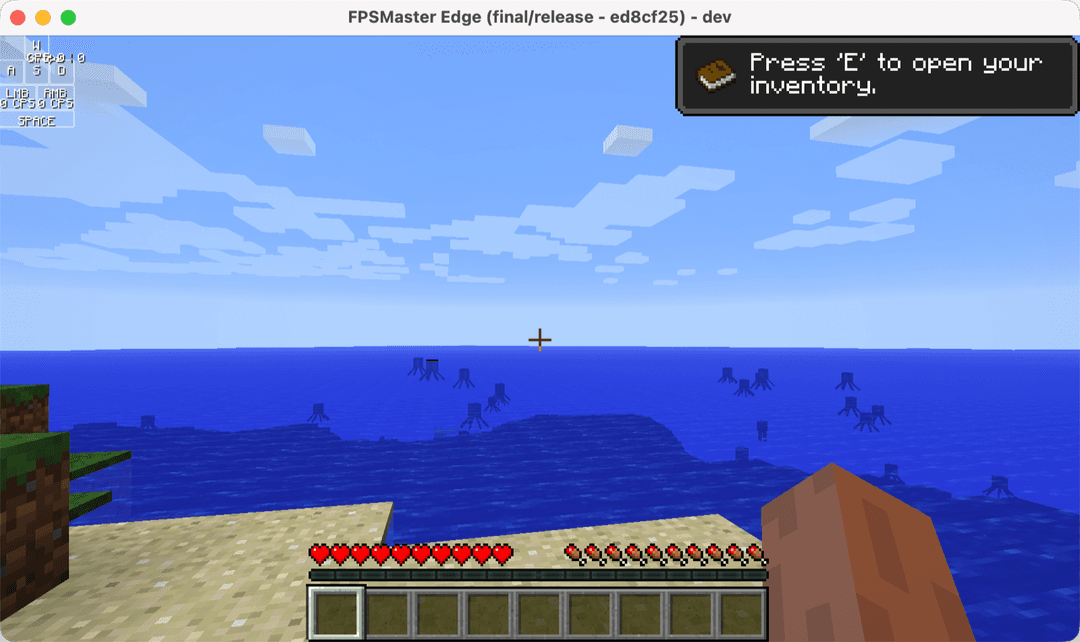
| Edge | 1.8.9 client | Forge mod, Mixin to change vanilla classes, a custom event bus, about 60,000 lines of Java | Final version 2.0.0, GPL-3.0 |
| Nova | Client for 1.19.2 to 26.2 | Fabric + Stonecutter, one source tree compiled for 6 MC versions, UI in CEF web pages or Prism | Final version 1.0.0, MIT |
| Extreme | An experiment to rewrite the 1.8.9 client in Rust | wgpu rendering, a hand-written protocol stack, JS plus native extensions, about 76,000 lines of Rust | Never playable, not in the final release, archived |
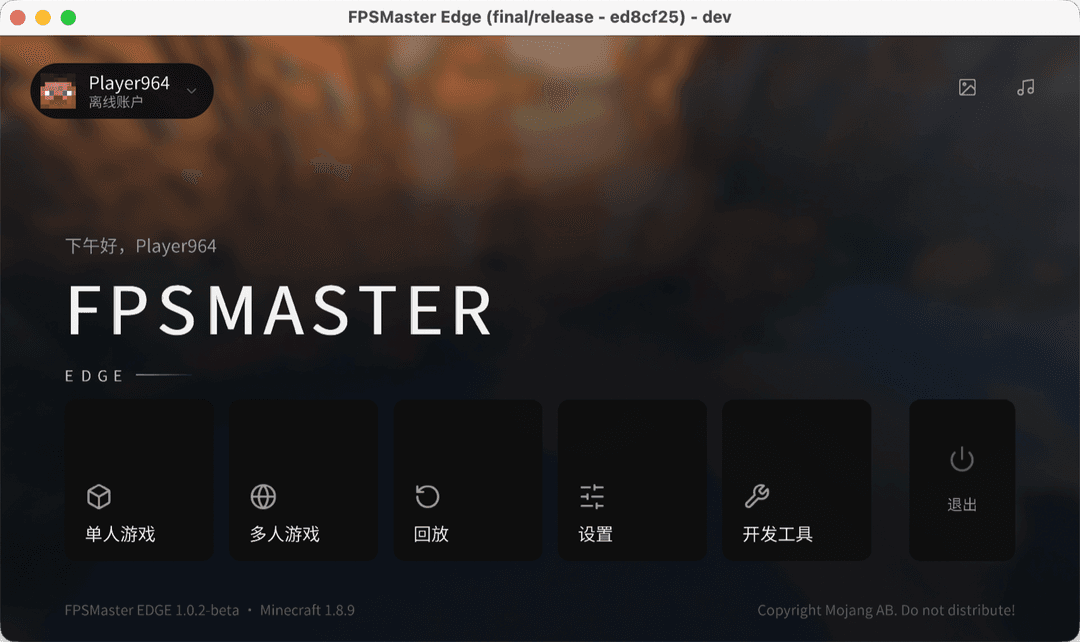
| Launcher | Launcher | Tauri 2 + React, download and launch core in Rust | Final version 1.0.0 |
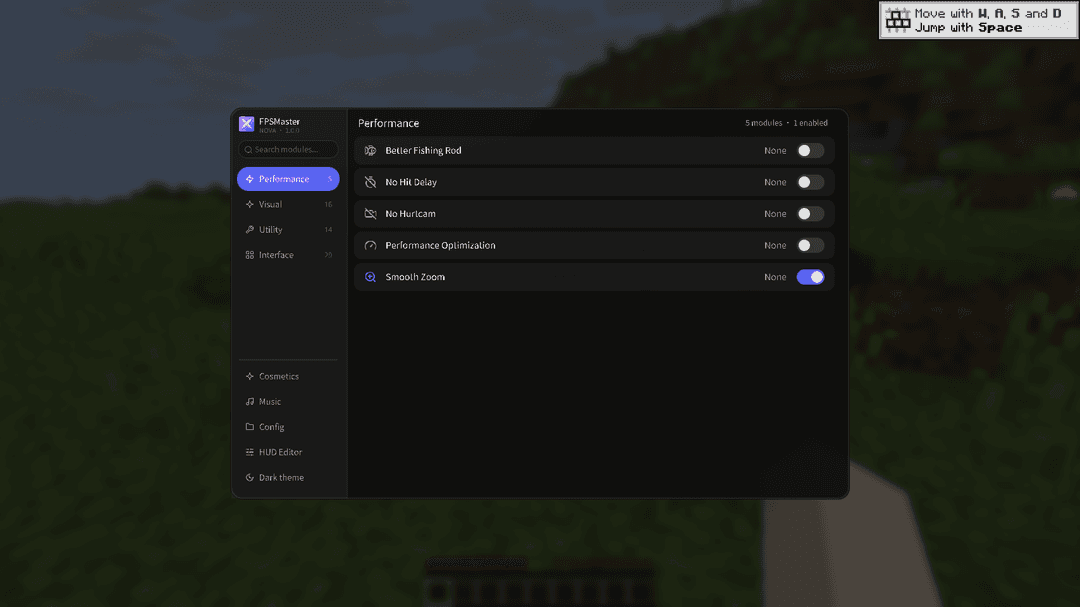
Edge's modules fall into four categories in the UI, 67 in total: optimization 7, visual 15, utility 14, interface 31. Nova has 64. These numbers come from the ClickGUI screenshots of the two clients.
Architecture
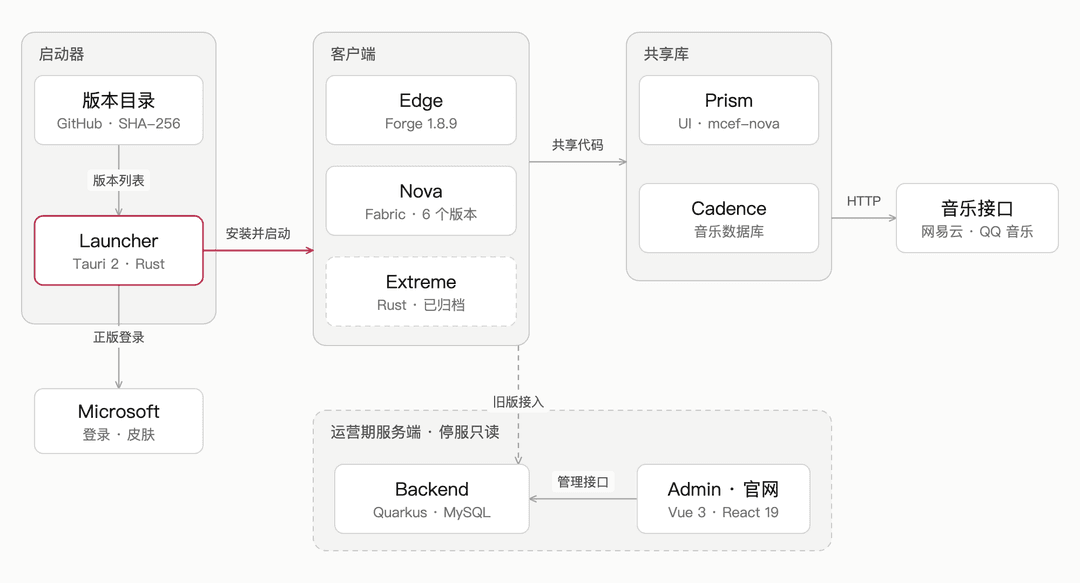
The client, launcher, backend, and website are released separately. Three shared libraries let them reuse code.
- Prism: a custom immediate-mode UI library in Java 8. It does not depend on Minecraft, LWJGL, or the loader. Edge and Nova each implement a
UiHostandCanvaslayer and share the same UI. - mcef-nova: a fork of CCBlueX/mcef. Upstream ships one artifact per MC version, because its rendering code is tied to Minecraft's pipeline. I removed that coupling so one jar works for all versions. GPU acceleration uses D3D11 on Windows and dmabuf shared textures on Linux. Everything else falls back to CPU.
- Cadence: a data client library for NetEase Cloud Music and QQ Music, in Java 8 with zero MC dependencies. It handles search, direct links, word-by-word lyrics, playlists, and QR-code login. I extracted it from Nova's music feature, and Edge uses it too.
Hard things I did
One source tree, six MC versions
Nova covers 1.19.2 to 26.2. That spans the rendering rewrite in 1.21.5 and the unobfuscated game in 26.x. In the source, Stonecutter comments branch the code along real API boundaries, and each version has its own Mixin list. 26.2 needs JDK 25 to compile, and the old GuiGraphics is supported through an adapter class. In November 2026 I ran a runClient acceptance check on all six versions. On each version it goes from the main menu into a world, opens the ClickGUI, opens the cosmetics screen, and goes back.
Measure first, then optimize
From 26 July to 1 August 2026, I did a performance sprint on Edge: 47 perf and fix commits, with 2,386 lines of raw notes. I only state conclusions backed by data:
| Change | Measured |
|---|---|
| EntityCulling, do not draw occluded entities | Frame rate +24.3%, GPU time -18.6% (scene dense with cosmetic entities) |
| Glyph lookup cache | HUD time -11.9%, the ranges of three rounds do not overlap |
| Texture upload | Load-time cost down from 160 to 183 ms to 36.5 ms |
| Reuse visible chunks | Terrain traversal -33% to -44% |
More useful were the assumptions that were overturned: 8 turned out wrong only after measuring, and 2 of those already had code written. For example, "doubling draw calls costs nothing": the gain only appeared when triangles were reduced. "Armor is the bulk of the entity layers": in fact held items took 59%, and one sword costs as much as nine pieces of armor. CullPlayers gave -4.5% in real PVP and is off by default. The rules I wrote into the report: the gain only appears when geometry is reduced, and when the GPU is the bottleneck, CPU section timings mislead.
Launcher
Tauri 2 plus Rust, with four installers: Windows x64, Windows 7, Linux, and Apple Silicon macOS. About 26,000 lines of Rust and 18,000 lines of frontend.
- Downloader:
.partresume, Range segments for large files, exponential backoff, multi-source failover, and mirror ranking by health. It fails fast when the network is down. - Offline direct launch: if the local files are complete it does not go online, and a missing file is reported at once.
- Windows 7: WebView2 109 is pinned, VC++ and UCRT are bundled, and it ships as a separate package.
- Security: credentials are encrypted with AES-256-GCM and the master key lives in the system keychain. ZIP extraction limits entry count, size, and paths, to guard against zip bombs and directory escape. Support bundles are redacted on export.
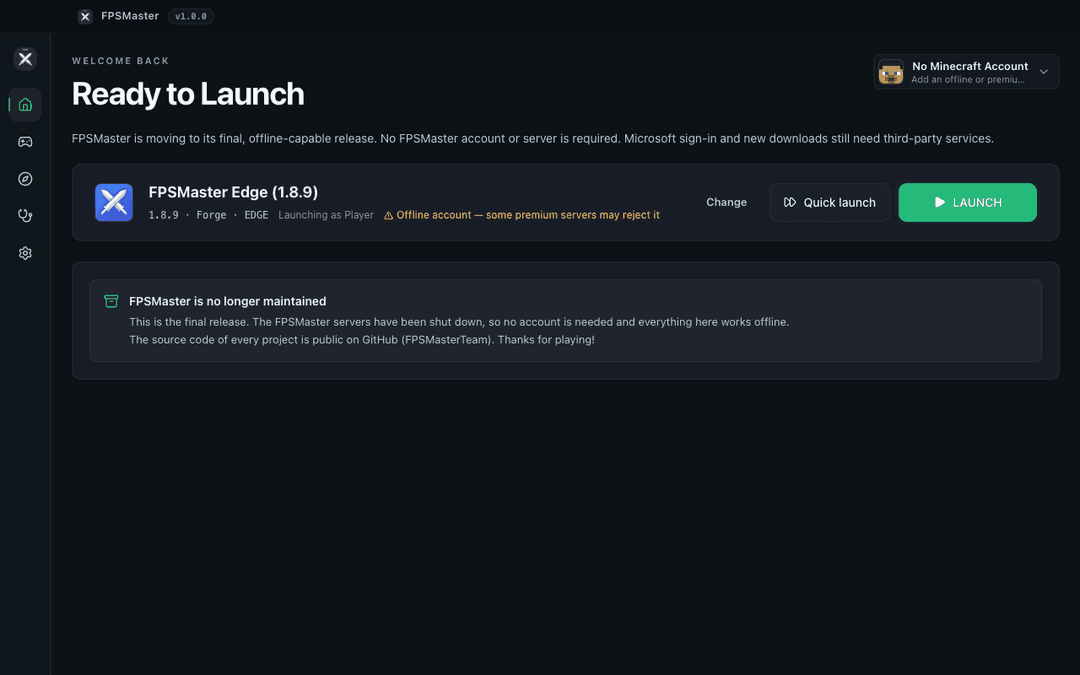
- Release: after the servers shut down, the version list and self-update read a static catalog on GitHub and only verify SHA-256.
Backend, accounts, and cosmetics
While in operation, the server was Kotlin + Quarkus 3, MySQL 8, with Flyway managing 28 migrations, JWT authentication, and about 26,000 lines. Features include accounts and permission groups, a forum, tickets, a release system, WebSocket chat, titles, and cosmetics configuration. The admin console uses Vue 3 and Vben Admin. The website is React 19 + Vite, with static entry pages generated at build time.
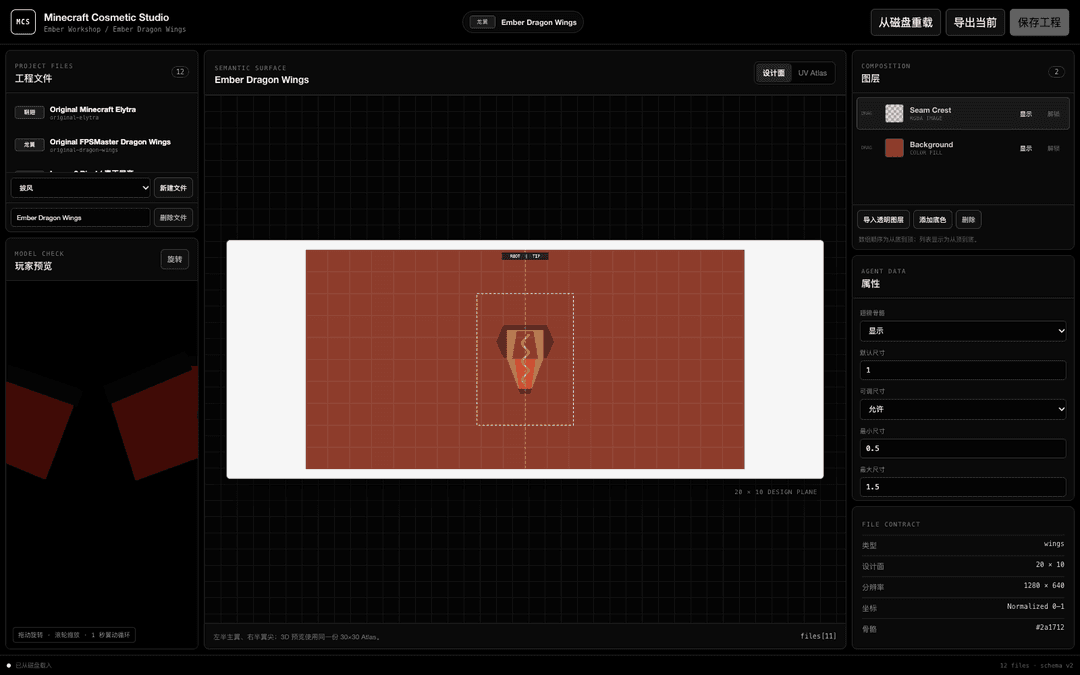
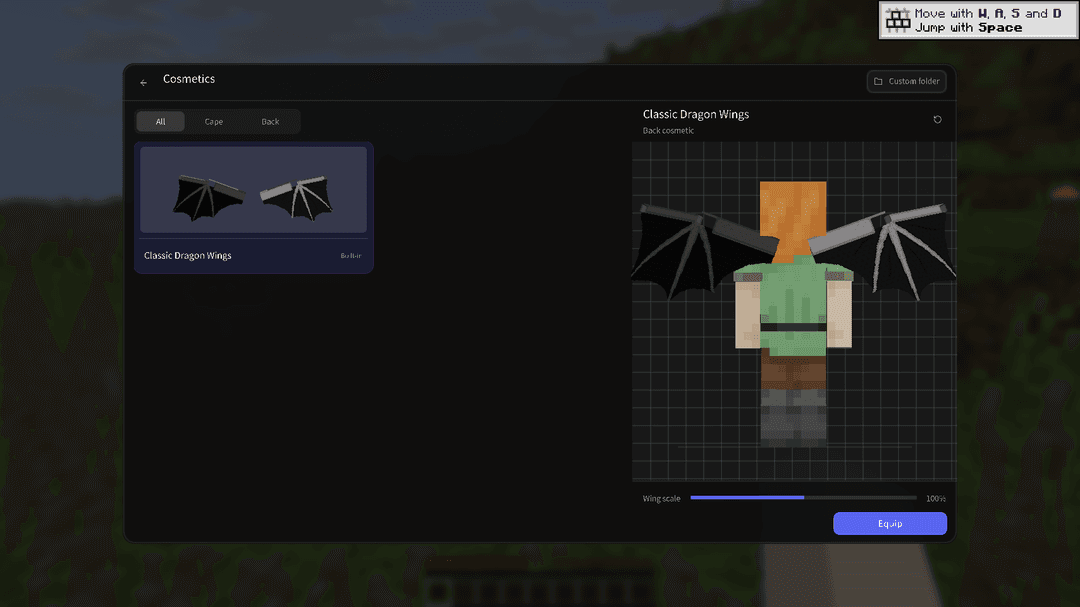
Cosmetics (capes, elytra, dragon wings) are stored by the server and rendered by the client. To make it easy for artists to produce them, I wrote a separate local tool, Cosmetic Studio. In each file you layer a background and transparent layers on semantic design faces, then export the matching Minecraft Atlas, with a 3D preview.
Scale
| Metric | Value | Source |
|---|---|---|
| Edge GitHub stars / forks | 235 / 45 | GitHub API, 2026-11-20 |
| Edge Modrinth downloads | 94,767 | Modrinth API, 2026-11-20 |
| Edge GitHub Releases downloads | 13,208 | GitHub API, includes assets of all releases |
| Website statistics | Over 20,000 registered users, over 250,000 downloads, over 50,000 lines of code, over 10 committers | The "About" section of the website, entered by the author, not checked against the backend |
| Edge commits | 793 | Local repository |
Current status
Maintenance stops on 31 December 2026. The final versions are Edge 2.0.0, Nova 1.0.0, and Launcher 1.0.0. None of them needs an FPSMaster account or server any more: accounts, the store, telemetry, recommended servers, and remote cosmetics are all removed. Cosmetics now load locally, and a cosmetic is shown only on yourself. The backend becomes read-only. Registration, posting, and tickets stop, while login and personal data export stay available long term. The website becomes a static archive, and the installers are on GitHub Releases.
Timeline
| When | Event |
|---|---|
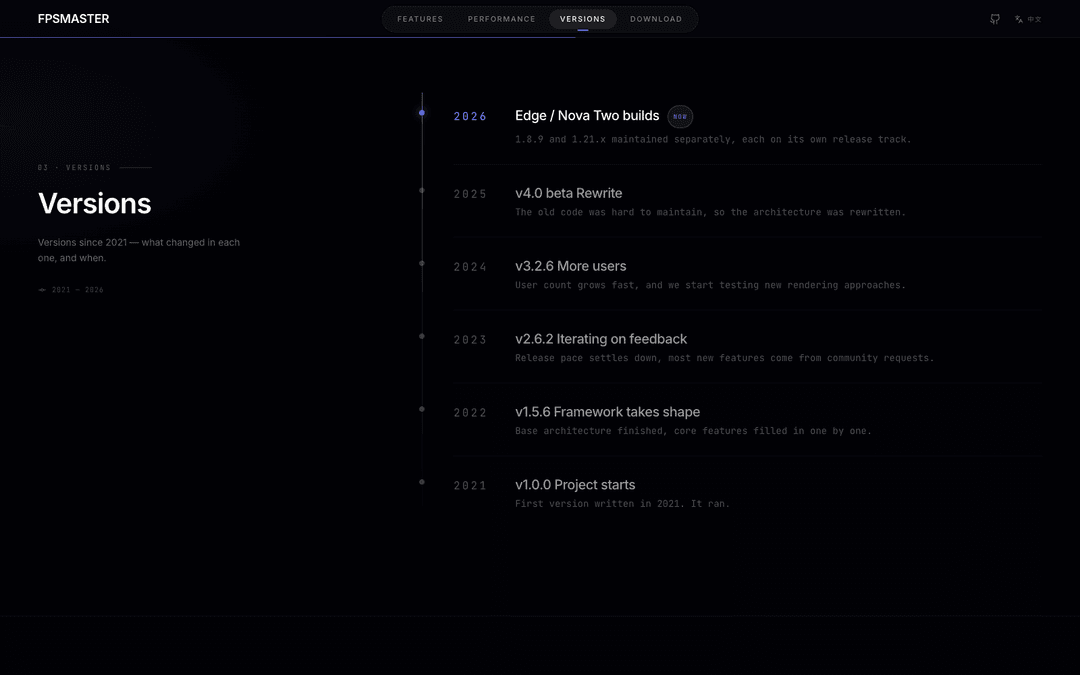
| 2021 | The website's version history says v1.0.0, the first version, was written this year |
| 2023-07 / 2023-08 | Frontend and old backend repositories created |
| 2024-06 | Edge source opened; first public release v3.2.9 in 2024-07 |
| 2025 | The website's version history says v4.0 beta rewrote the architecture |
| 2026-01 | Nova started; Edge dropped its multi-version wrapper and kept only 1.8.9 |
| 2026-02 | Launcher, new backend, admin console, new website |
| 2026-06 to 2026-08 | Extreme experiment, mcef-nova, Prism, Cadence, Edge performance sprint |
| 2026-11 | CI removed, switched to manual releases, six MC versions accepted, final versions |